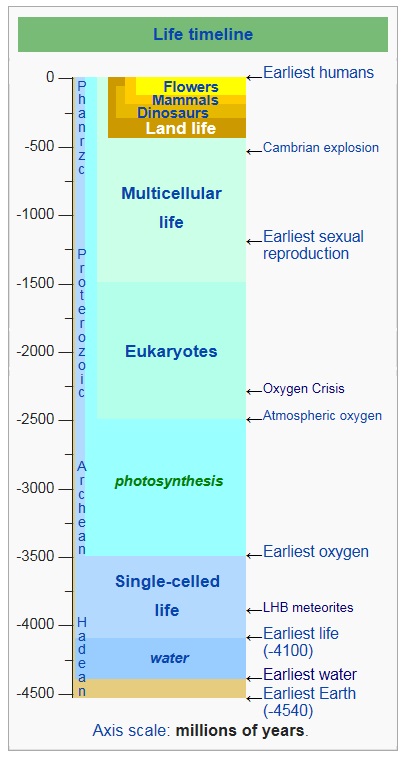
How do we know the scale of Earth's history?
We have techniques to put dates to events recorded in the sedimentary rock record.
Geologic time, the total time involved since formation of the earth to the present time, is a concept that most people have a hard time grasping. The problem is not so much that it is hard to understand that the earth has a history of events that have taken place on it. The fact that most of this history predates the appearance of human beings on the planet gives some people pause, but most of us can deal with this at a purely intellectual level at least. The real problem is the scope of this history. 4 billion years is not a figure that our minds are equipped to deal with.
How do we know the scale of Earth's history?
We have techniques to put dates to events recorded in the sedimentary rock record.
There are two strategies for dating geological events. The first strategy is to construct a relative calendar of events: we look at how one geologic feature formed in the relationship to another. We use the principles of stratigraphy to determine the order in which rock layers were deposited. The second strategy became available in later times as technology developed to allow geologists to calculate the true age of rock layers in years before the present. These methods make use of the decay of radioactive elements. Geologists use the same rate law equations that you learned in grade 12 chemistry to derive equations to calculate the age of a mineral from the ratio of the reactants and products of a given radioactive decay process.
Relative dating allows geologists to place events into the correct sequence.
Absolute dating allows them to assign specific dates to these events.
The end result of this is what we call the geologic time scale.
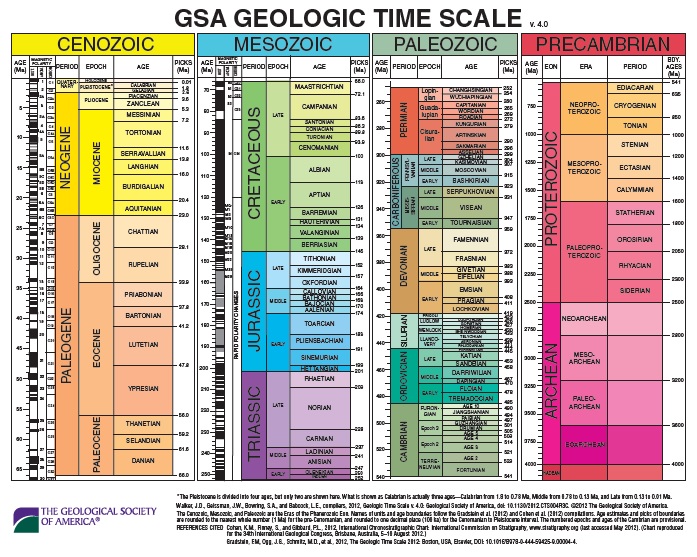
There are two ways of discussing earth history: from the point of view of time, and from the point of view of the rocks preserved from that time. It is important not to get these two perspectives confused. In different parts of the world different spans of time are preserved in the rock record. The cambrian rocks in one locality might comprise different spans of time as compared to those in other localities. This is because there may be no rocks deposited during some time spans at some localities, or rocks that are deposited may be eroded. Unconformities can encompass time spans just as do rock layers. It even is possible that some time spans may not be represented by rocks anywhere on the earth. So, we have a hierarchy of terms that describe the rock layers deposited during a given time span, and a separate set of terms that describe the time intervals themselves.
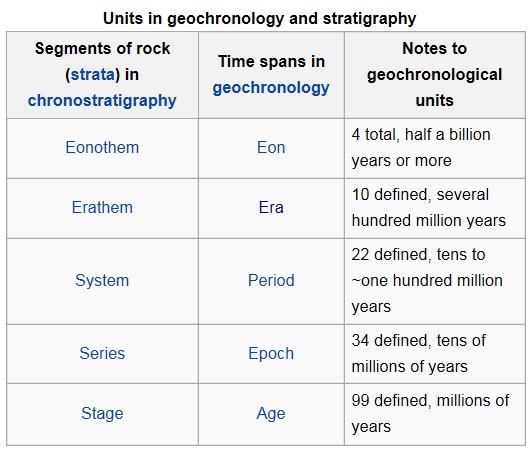
For example, the Cambrian System is the sequence of rocks that were deposited and preserved during the span of time called the Cambrian Period.
Each hierarchy uses the same descriptors: Cambrian, Ordovician, etc. We just make sure that we are talking about rocks or time in any conversation.
In order to avoid confusion about what span of time each descriptor means, they upper and lower boundaries of each system, stage, Erathem etc. is defined by a particular layer in a strategraphic sequence of rocks at a particular place called a Type Section (or Type Locality). These layers become the "legal" definitions of what it means to be in a particular rock unit. The boundaries then have to be correlated to all other locations on the earth, either by the tracing rock layers, or by absolute dating of the layers.
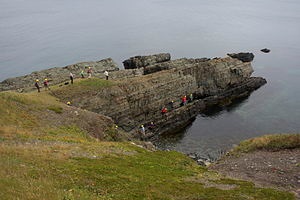
For example, the Cambrian/Precambrian boundary is defined by the lowest occurrence of a type of burrowing called "Phycodes pedum" at a rock section in Fortune Head, Newfoundland.
Go to Berkeley University 's introduction to Geologic Time and complete the activities within it. These will give you an introduction to the concepts involved in both relative and absolute dating.
The Berkeley University Virtual Geological Time Machine (http://www.ucmp.berkeley.edu/help/timeform.html ) has a good summary of the different geological time periods that have been defined, the dates at which each time period began and ended, and the significant biological and geological events that took place within each time period. One of you assignments for this activity will be to contruct a representation of the geological time scale. This link will probably be your best resource for this assignment.
The history of the geologic time scale is long and tortuous, as you might expect given that the concept is as hard to grasp as it is. Strong differences of opinions (such as between the catastrophists and uniformitarianists) added to the time it took to reach our present state of knowledge. Finally, the development of concepts in nuclear physics and technology for radioactive dating held up the final part of the picture until the last century. A summary of process by which the time scale came together as well as a history of some of the personalities involved can be obtained from the following links.
Catastrophists
Uniformitarianism
Nicholas Steno: http://www.ucmp.berkeley.edu/history/steno.html and http://faculty.uca.edu/~benw/biol4402/lecture4/sld001.htm
James Hutton's: http://www.james-hutton.org.uk/
William Smith: http://www.ucmp.berkeley.edu/history/smith.html